The MLB Draft Lottery sunset may be here. It may once again be a relic of yesteryear.
This isn't a hot take for the sake of one. It's just where the calendar and the bargaining table have left us. The lottery is four years old, it has not done the job it was hired to do, and the labor agreement that created it runs out on December 1. Everything after that date is a mystery, especially as it pertains to the MLB Draft. The format, the odds, the penalties, even whether the thing exists at all. Teams that spent all summer losing games will presumably walk into next spring still not knowing where they pick.
The current Collective Bargaining Agreement expires December 1, and the draft -- its structure, its order, its mechanics -- is not agreed upon by the league and the MLBPA one day past this season. Not the lottery, not the bonus pools, not the pick penalties, none of it. The whole draft machine was a product of the 2022 CBA, and when that document dissolves, another blank canvas awaits.
The lottery has been held in December, during the Winter Meetings, as the offseason gets going. But if the owners lock the players out on December 1 (and every signal in the industry says a work stoppage is very much going to happen) there is no lottery held until baseball comes back online. You don't run the league during a lockout. There are no ping pong balls.
This all assumes the lottery even returns in its current shape once the lights come back on. A lockout that drags into the new year doesn't just delay a televised lottery ceremony. It leaves clubs genuinely not knowing where they're selecting in a draft that could happen just a couple months after the lockout ends. In some ways, scouting departments plan their entire spring around draft position. They prioritize certain players over others, assuming they'll pick in one spot and not another. The Seattle Mariners were expected to pick 17th in the 2025 MLB Draft before leapfrogging the competition up to pick No. 3 thanks to the lottery. Do you think they would have spent much time on Kade Anderson before that happened? Unlikely.
But here's the thing. Maybe scrapping the event altogether is the way to go.
The lottery hasn't done its job.
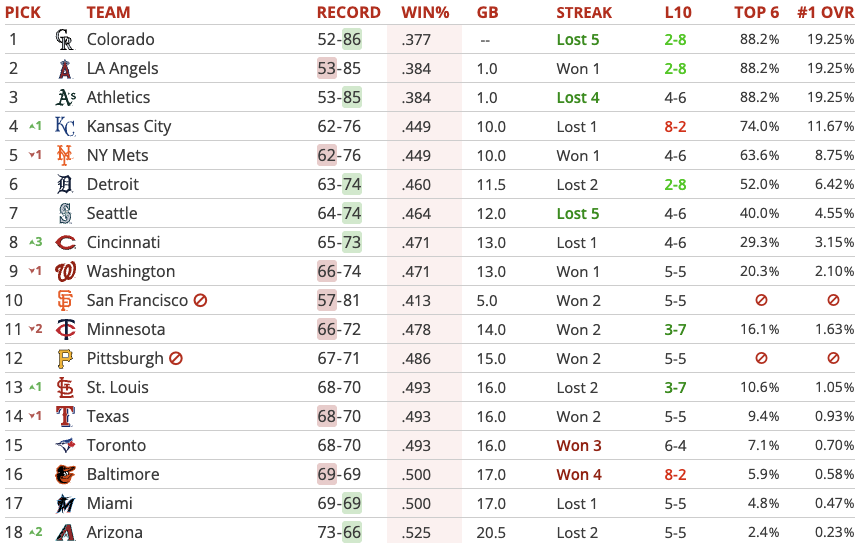
Rewind to why it existed. Both the league and the union signed off on a draft lottery to solve two problems at once. The league wanted to discourage tanking. You know, the practice of stripping a roster to the studs to lose your way to the top of the board. The union wanted losing teams to stop being rewarded for losing, and, in the bigger picture, wanted a system that nudged clubs toward spending and competing rather than bottoming out on purpose. Parity was the north star. Spend more, tank less, spread the talent around.
Three years in, it has accomplished neither.
It is not increasing parity. It is not encouraging anyone to spend a dollar they weren't already going to spend. What it has actually become is a punitive tool aimed at the cellar. It's become a randomized penalty box for the teams at the very bottom. Most of those struggling teams are trying to win. They're not all tanking. I would argue none explicitly are, actually. A lot of them are just bad, or young, or unlucky, or three years into a rebuild that hasn't turned yet. Owners can always spend more money, that will be the case forever. In perpetuity. But front offices are trying to win. Teams lose 95 games in a season they were genuinely trying to compete in, they earn what should be premium draft real estate. But a couple of lucky clubs a few rungs up the ladder jump the line on lottery night and shove them down a few spots anyway. Neither side of the equation earned that outcome.
A team does everything the standings ask of it, and a bouncing ball decides it drops from second to fifth. There's no competitive lesson being taught there. There's no incentive being corrected. It's randomized chance dressed up as parity reform, and it lands hardest on the franchises least equipped to absorb it. The league was supposed to build a system that discourages tanking. Instead it built one that occasionally punishes the teams that weren't tanking in the first place, and does nothing to move the needle on the spending behavior it actually cared about.
When a mechanism fails to deliver on the single reason both parties were aiming to address, it becomes very easy for both parties to put it on the table. And that's exactly where the lottery sits right now.
The lottery could go away completely, replaced by something else altogether. And that's been bandied by the MLBPA and the league in preliminary CBA discussions.
I think there's genuine appetite on both sides to rethink the draft's front end. We could see a rebuilding of the event, rather than tinkering at the margins. Once you accept that the current setup isn't producing parity or spending discipline, "let's fix the odds" starts to feel like reupholstering a car with a sputtering engine. Why patch a system that's whiffed on its mandate when the whole thing is already open for negotiation?
What replaces it is anyone's guess, and I'm not going to pretend to have the sources to tell you the new model is "X". It could be a straight worst-to-first order again. It could be some performance-based or market-based mechanism nobody's floated publicly yet. It could be a hybrid that keeps a lottery element but reweights it so the bottom teams can't get leapfrogged the way they do now. The point isn't the solution. The point is that "blow it up and start over" is a very real option.
There is a version of this where none of the chaos happens. The league and the MLBPA could agree to hold the lottery before December 1, get the order locked in ahead of the CBA expiring, and take the whole delay problem off the board. Clean, tidy, everybody knows where they pick.
But would that be an exercise in complete futility? Holding the lottery early only helps if the lottery stays exactly the same — same odds, same eligible teams, same anti-tanking penalties, same everything. And getting both sides to agree to run the existing format one more time, untouched, right as they're squaring up for a labor fight over that very machinery? I'll believe it when I see the balls in the hopper. That outcome asks two parties who can't agree on the future of anything to agree, at least once more, on its present. It takes a bargaining chip, if even miniscule, out of both parties' hands. It's possible. It seems extremely unlikely.
The most likely path is that the draft's front end goes into the CBA negotiations as an open question, the December lottery we've grown used to doesn't happen on schedule, and the teams with the most invested in draft position spend the winter, maybe into the spring, not knowing where they stand. The best case is a quiet agreement to run it one more time as-is, which I wouldn't wager on. The most interesting case is that both sides finally admit the experiment didn't work and build something new in its place.
Whatever comes, the draft lottery as we've known it for four years is not something you should assume is coming back. It was sold as a fix. It fixed nothing. Hell, it may have broken more than it fixed. In a negotiation, a tool that nobody's happy with is exactly the kind of thing that doesn't survive the next handshake.
Perhaps the most uncertain draft cycle in a generation is just getting started.