59,851 picks. Every one of them graded.
The MLB Draft is the most beautiful guessing game in sports. Every summer, 30 front offices spend millions of dollars and thousands of man-hours trying to predict what a 17-year-old will look like at 27. Some of those guesses turn into Barry Bonds. Most of them never see a big-league box score.
Today, Over-Slot Baseball launches the MLB Draft Archive, an interactive home for every June draft from 1977 through 2026. Every pick, every club, every outcome: debut dates, career fWAR, full MLB stat lines, signing bonuses and a clean measure of how each pick performed against the value his draft slot historically produces.
It's built for draft obsessives and, fair warning, it's very easy to lose an afternoon in.
Every draft, rebuilt from the ground up.
Pick a year from the home page and you get the full board: every round, every club, every player. Each draft page opens with the headlines (the No. 1 pick, the best player in the class, total class fWAR, MLB debut rate, first-round hit rate and the class's performance against slot), the visual aids that show where the value actually landed:
• Where the value came from. A scatter of every big leaguer in the class by overall pick and career fWAR. In 2013 you can watch Aaron Judge tower over pick No. 32 while Cody Bellinger and Jeff McNeil sit out in the deep rounds.
• fWAR by round. A donut showing how much of the class's value came from the first round versus everything after it.
• How the picks turned out. The share of signed picks who never reached the majors, plus the spread of outcomes for those who did.
• Team haul. Every club ranked by what its picks produced. Click a team and the board filters to its selections.
Below that sits the draft board itself, with Overview, Hitting and Pitching views. Sort by anything: pick, age at draft, bonus, slot value, debut date, seasons, career fWAR, expected fWAR or vs. slot. Search by player or school, filter by team or round, or narrow to big leaguers only.
Player cards. Click any name and his card opens: draft slot, school, hometown, age on draft day, bonus vs. slot, MLB debut and career line, career fWAR, expected fWAR, his number against slot and where he'd go in a re-draft. Each card also shows the picks made right before and after him. Add any two players, from any two years, to compare them side by side. Trout against Strasburg is a good place to start.
GO TO MLB DRAFT ARCHIVE
There are a few particular features we're particularly proud of...
"Vs. slot" was really the impetus of this whole thing. It's the number this whole thing is built on. Career fWAR tells you who was good. It doesn't tell you who was a great pick. A No. 1 overall selection is supposed to become a star; a 22nd-rounder isn't. So every signed pick gets an expected fWAR: the average career value of players taken in the same pick range, from the same school level (high school, four-year, junior college) and the same era of drafts. "Vs. slot" is simply career fWAR minus that expectation. Aaron Judge comes out at +59.2. Mark Appel, the 2013 No. 1 pick, sits at −19.7. Hover over either column header anywhere in the archive for the full definition.
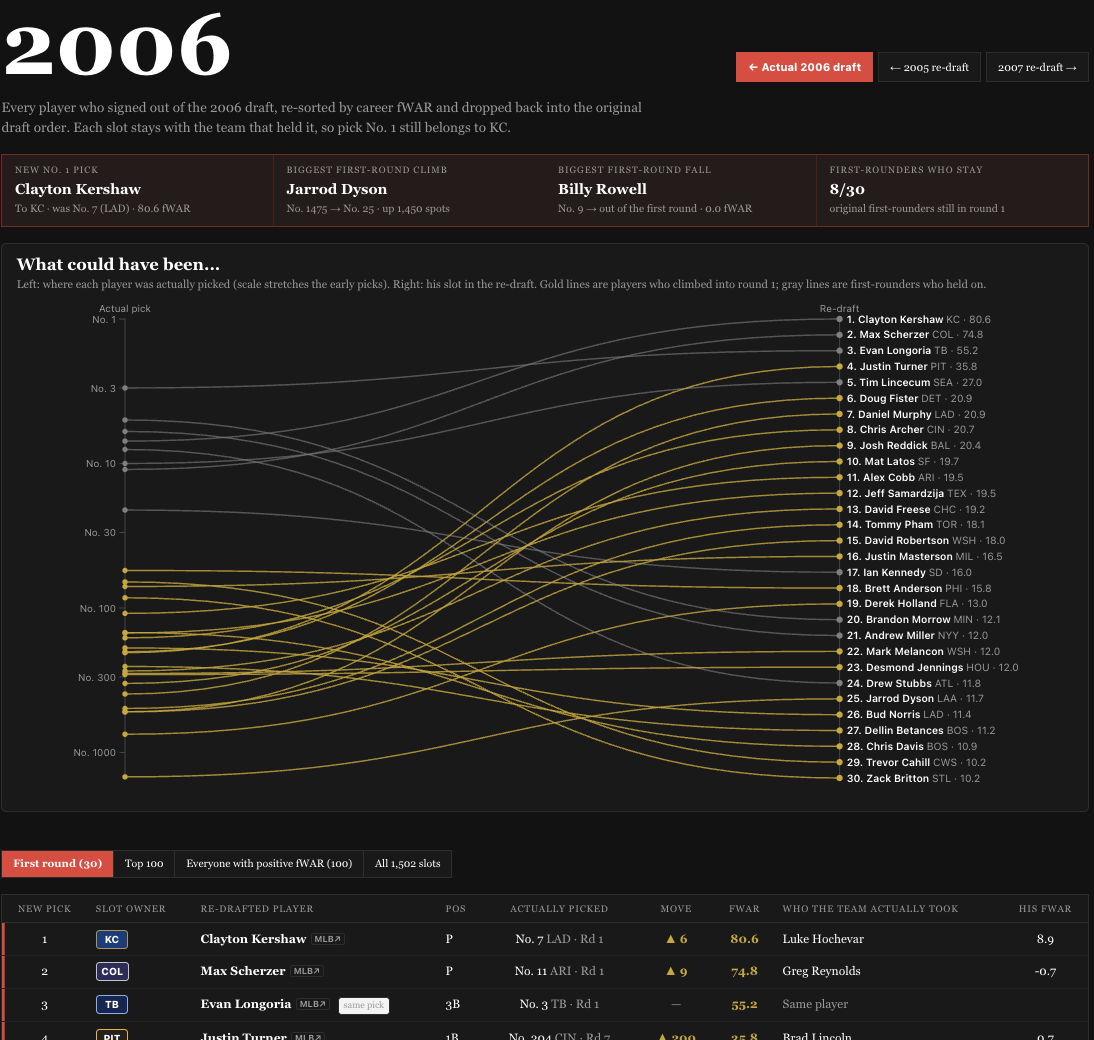
The RE-DRAFT button. Every draft page has one, and it's the most dangerous button on the site. Hit it and the class gets re-sorted by career fWAR and dropped back into the original draft order, with each slot still belonging to the club that held it. Judge goes No. 1 to Houston in 2013. Mike Trout goes No. 1 to Washington in 2009, one pick ahead of Stephen Strasburg. The What could have been... chart traces every new first-rounder from where he was actually taken to where he lands now, and the board shows exactly who each team took instead.
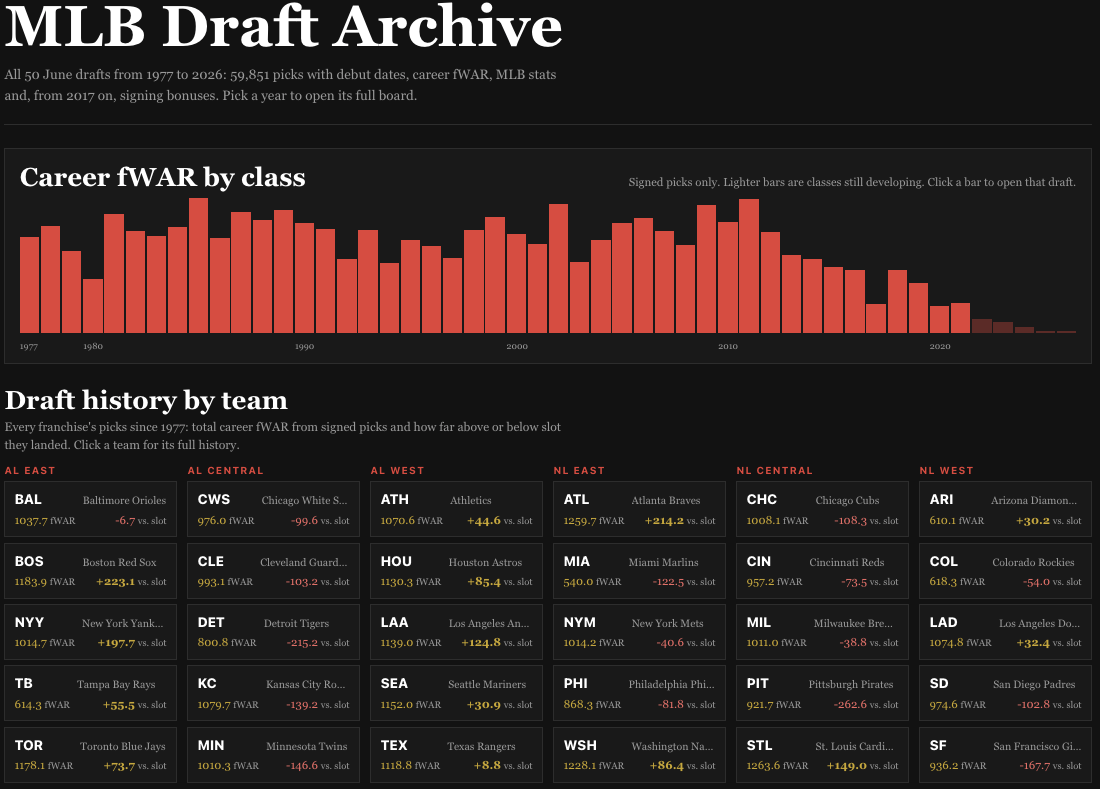
Team pages for all 30 franchises. Every club's draft history since 1977 (or since its first draft): total fWAR and league rank, performance against slot, best pick ever, first-round hit rate, a class-by-class chart against the league average, its 15 best picks and every selection it has ever made. Relocated and renamed clubs stay together, so the Expos live with Washington and the California and Anaheim Angels live with today's Angels.
19 all-time leaderboards. Biggest steals, biggest busts, the biggest re-draft jumps, every No. 1 pick ranked, the best player taken at each of the first 100 picks, the best from every round, late-round gems, players who went straight to the majors, the best hitters and pitchers drafted, the best at each position, the longest careers, the top college programs, the best team draft classes, the best over-slot signings and, my personal favorite, The ones that got away: stars who didn't sign with the team that first drafted them. Bonds (Giants, 1982), Clemens (Mets, 1981), Randy Johnson (Braves, 1982) and Aaron Judge (A's, 2010, 31st round) all live there.
Over-Slot, baked in. For the 2021 through 2026 drafts, every drafted player who appeared on Over-Slot's board carries his Over-Slot rank in a sortable column, and his name links straight to his Over-Slot player page. Line our board up against where players actually went, and soon enough, against how they turned out.
So where should you begin?
A few rabbit holes worth falling into on day one:
1. Open the 1985 draft and hit RE-DRAFT. Bonds, Randy Johnson, John Smoltz (a 22nd-rounder), Rafael Palmeiro and Barry Larkin. Only 12 of the 28 original first-rounders hold their spot.
2. Check the Biggest steals leaderboard. Bonds leads at +139.1 over slot, followed by Roger Clemens and Greg Maddux.
3. Pull up your team's page and find its best and worst classes on the year-by-year chart. The 1990 Yankees class (Jeter, Pettitte, Posada) towers over everything around it.
4. Late-round gems. Albert Pujols in the 13th round. Mike Piazza in the 62nd. Ryne Sandberg in the 20th. Scouting is hard, my friends.
5. Compare two No. 1 picks. Open any two player cards, hit Add to compare, and settle the argument.
Read this before you dive in
A tool like this is only as honest as its fine print, so here's ours.
• Where the numbers come from. Picks, schools, debuts, signing bonuses and slot values come from the MLB Stats API. Career fWAR and stat lines come from FanGraphs and run through the end of the 2026 regular season. The archive is a snapshot as of October 2026, not a live feed. The tool will be updated monthly.
• fWAR is credited only to signed picks. If a player didn't sign and went back into the draft, his row is grayed out and his value belongs to the pick where he finally signed. Gerrit Cole's 48.7 fWAR belongs to Pittsburgh in 2011, not the Yankees in 2008.
• June/July drafts only. The January and secondary phases that ran before 1987 aren't included.
• Bonuses and slot values start in 2017, the first year MLB published them for every pick.
• Recent classes are still cooking. Anything after 2021 is marked as developing, and the 2026 class hasn't produced a big leaguer yet. Re-drafts and "Vs. slot" for those years will move a lot.
• How expected fWAR works. Picks are grouped into ranges (1–5, 6–10, 11–20, 21–30, 31–50, 51–75, 76–100, 101–150, 151–200, 201–300, 301–500, 501+), by school level and by five-year era of drafts. From 2015 on, players are compared only to their own class, because careers that young are at very different stages even a year apart. Unsigned picks are left out of the averages.
• Eras matter on the busts list. The late-1980s drafts produced so many stars near the top that the bar for those early picks sits very high, so top-10 picks from that era dominate the Biggest busts board. The busts list only covers drafts through 2016, so no one gets judged on an unfinished career.
• Team names follow the era. Picks show the club name of the day (CAL, ANA, MON, FLA, OAK), while team pages group each franchise's full history together.
• Positions are as listed on draft day, and college names come straight from MLB's records, so a school listed under two names gets split on the Top college programs board.
Go break it.
Every summer we argue about who got it right. Now there's a place to settle it, 50 drafts deep.
The MLB Draft Archive is live now at OverSlotBaseball.com. Open your team, hit RE-DRAFT on your favorite class, and tell us what we missed.